Before you rent or buy in Brisbane, check the flood information for the exact address, not the suburb's reputation. Brisbane City Council publishes two free tools for this: the Flood Awareness Map, which shows the likelihood and type of flooding across the city, and the FloodWise Property Report, which gives property-specific information including ground levels and the flood levels that apply to that lot. Both are linked from Council's check your disaster risk page.
This independent Trusted Locally guide explains how to use those tools, what the terms on them mean in plain language, and what to ask the agent, your insurer and any professional you engage once you have read them. It cannot assess an individual property or replace specialist advice, and a map is never a substitute for current emergency warnings. Information was checked on 1 October 2026.
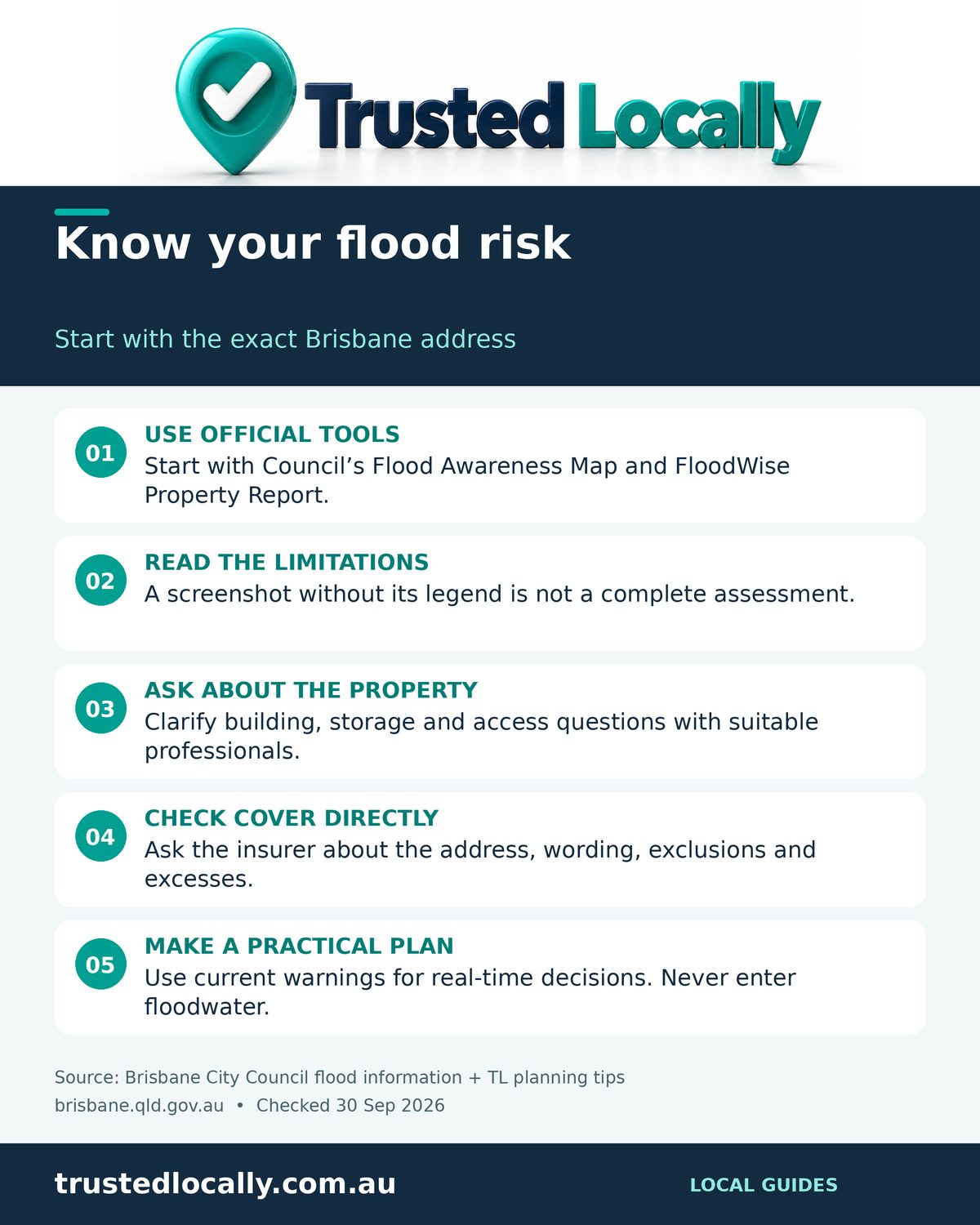
Step 1: Use the Flood Awareness Map
The Flood Awareness Map lets you search an address and see whether it is affected by river, creek, overland flow or storm tide flooding, and how likely each is. Read the legend before you read the colours. The map groups likelihood into bands such as very low, low, medium and high, and each band has a technical definition. The map shows awareness information drawn from Council's flood studies; it is not a record of what happened at a particular house in 2011 or 2022, and it does not predict what will happen in the next storm.
The four types of flooding on the map
- River flooding: the Brisbane River rising after prolonged heavy rain in the catchment, often over days. Slower to arrive, slower to leave.
- Creek flooding: local creeks rising quickly after intense rain. Can happen with little warning and recede within hours.
- Overland flow: rainwater running across the ground before it reaches a drain or creek. Common in low points, driveways and against retaining walls, and the type most often missed by buyers.
- Storm tide: seawater pushed inland by a cyclone or severe low, relevant to bayside and river-mouth suburbs.
Step 2: Get the FloodWise Property Report
The FloodWise Property Report is a free PDF for a specific lot. It shows the ground levels on the property, the applicable flood levels and the flood planning information that would apply to building work. Check that the report is for the correct lot, especially in unit complexes and on battle-axe blocks, and read the explanatory notes rather than just the numbers.
What the terms mean
- AHD (Australian Height Datum): the national reference for height above mean sea level. Ground levels and flood levels in the report are given in metres AHD, so you can compare them directly.
- 1% AEP (annual exceedance probability): a flood with a 1 in 100 chance of being equalled or exceeded in any given year. It is not a flood that happens once a century; over a 30-year mortgage the chance of at least one such event is roughly one in four.
- Defined flood level / flood planning level: the levels Council uses for planning and building decisions, which include a safety margin above the modelled flood level.
- Minimum habitable floor level: the height that new habitable rooms would need to be built to on that lot.
If the lowest ground level on a lot sits below the flood planning level, that does not automatically mean the house floods, because the floor may be elevated well above the ground. It does mean you should ask about the actual floor level and about garages, storage areas and access.
Step 3: Ask questions about the exact address
Write down the questions the reports raise and put them to the owner, agent or body corporate in writing. Useful ones include:
- Has the property, including the garage, yard or under-house area, ever had water in it? When, and from what source?
- What is the floor level of the main living areas relative to the levels in the FloodWise report?
- Have there been drainage, retaining wall or flood-related repairs? Is documentation available?
- For a unit, which levels are car parks and storage on, and what does the body corporate's insurance cover?
- Is there a flood-related condition on the title, a planning overlay or a building approval that affects renovation?
If you are making a major commitment, pay for suitably qualified advice to interpret technical information. A building inspector, surveyor or engineer can read a site in ways a sunny-day viewing cannot. For renters, the questions are the same but the decision is simpler: ask, read the answers, and factor them into whether the rent is fair for the risk. Our Brisbane renters' moving checklist covers the rest of the move.
Step 4: Think beyond the front door
A house above flood level on a street that goes under is still a house you cannot leave. Look at the map for the roads you would use to reach work, school, daycare and the shops, and for the low points you drive through every day. This is a planning exercise, not a prediction, and during an actual event you should rely on official road closure information rather than memory.
For a business premises, think about stock, equipment, customer access and supplier deliveries. For a household, think about pets, mobility needs, medication and where important documents are kept. Two people considering the same property can reach different conclusions because their practical exposure is different.
Insurance: ask about the address, not the suburb
Flood cover is priced on the specific address and insurers use their own data, so two houses on the same street can receive very different quotes. Before you commit to a property, get an indicative quote for it. When you read a policy, check:
- The policy's definition of flood, which in Australia is standardised as water escaping from a river, creek, lake, dam or similar body, and whether flood cover is included or optional.
- How storm water and rainwater run-off are treated, since overland flow is often covered differently from river flooding.
- The flood excess, which can be far higher than the standard excess.
- Any exclusions for actions of the sea or storm surge if you are near the bay.
A map is not an insurance quote, and a quote is not a guarantee of what a policy will pay. Keep a record of the information you relied on and the questions you asked so you can refer to it later.
Turn awareness into preparation
Once you understand the official information, build it into how you live in the property. Keep an emergency kit, store important documents and valuables above ground level, know where you would move a car to, and decide how your household will communicate during a disruption. Our Brisbane storm preparation checklist covers what to do before and during severe weather, and Council's and the Bureau's warnings should drive your real-time decisions. Never use an awareness map to decide it is safe to enter floodwater. If it's flooded, forget it.
Revisit the information when things change
A new address, a growing household, a home-based business or a renovation can all change the questions you need to ask. Keep the official links with your property records so you can find them again, and re-check the FloodWise report before any building work, because the planning levels apply to what you build.
When you need help with the property itself, Trusted Locally lists Brisbane plumbers, builders, landscapers and real estate agents by suburb with customer reviews. Check their licences and insurance independently, and use Council's tools and qualified advice to understand the location.
Frequently asked questions
How do I check if a Brisbane property is in a flood zone?
Search the address on Brisbane City Council's Flood Awareness Map to see the likelihood and type of flooding, then download the free FloodWise Property Report for lot-specific ground and flood levels. Both are linked from Council's check your disaster risk page.
What is a FloodWise Property Report?
A free report from Brisbane City Council for a specific lot showing ground levels, applicable flood levels in metres AHD and the flood planning information that applies to building work. It helps you compare the land and floor levels against modelled flood levels.
What does 1% AEP mean on a Brisbane flood map?
A 1% annual exceedance probability flood has a 1 in 100 chance of being equalled or exceeded in any year. It does not mean once every hundred years. Over 30 years the chance of at least one such flood is roughly one in four.
Does a low flood likelihood mean a house will never flood?
No. The map shows awareness information from flood studies, not a guarantee. Overland flow in particular can affect properties outside river and creek flood areas, and conditions in a real event depend on rainfall, drainage and the catchment at the time.
Is flood insurance compulsory in Brisbane?
No, but most home insurers include or offer flood cover and price it on the exact address. Get an indicative quote for the property before you commit, and read how flood, storm water and run-off are each defined and excessed in the policy.