Brisbane 2032 generates a steady stream of headlines about stadiums, transport links and the city's future. The Games Independent Infrastructure and Coordination Authority, known as GIICA, is the body responsible for delivering 17 new and upgraded venues, including the planned main stadium at Victoria Park and a national aquatic centre. Its website is the starting point for anything about venue progress.
For most residents and small business owners the useful question is narrower than the headlines: what has actually been confirmed, what stage is it at, and could it change the way you use your street, your park or your shop? This independent Trusted Locally guide shows you how to follow the developments that matter to you with a handful of reliable sources, and how to tell a confirmed decision from a forecast or a rendering. Information was checked on 1 October 2026.
Who is responsible for Brisbane 2032 venues?
Several organisations share the job, and one announcement rarely covers everything:
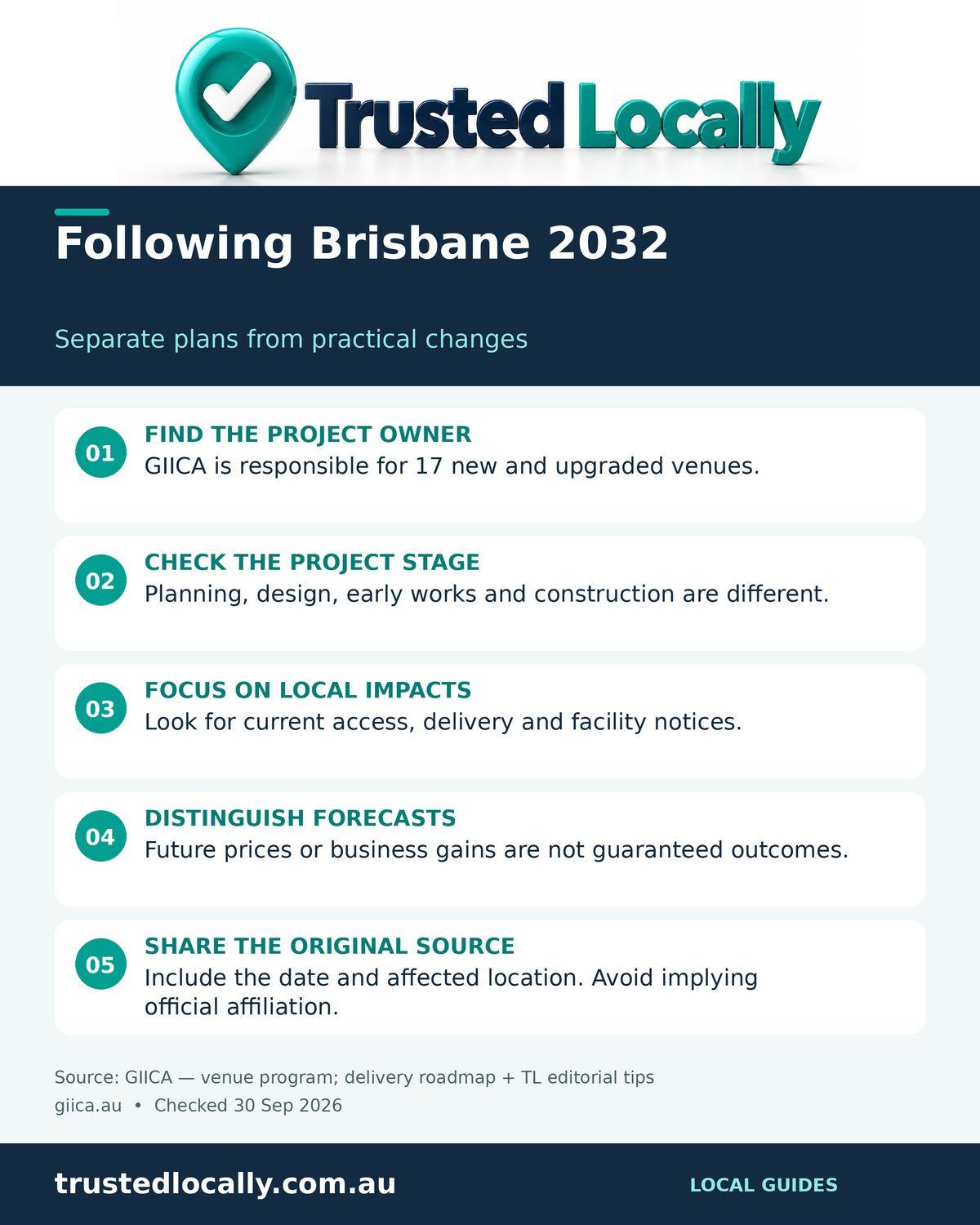
- GIICA coordinates and delivers the venue program. Its delivery roadmap explains how projects move through phases between now and 2032.
- The Queensland Government funds and approves major projects and is responsible for most transport infrastructure.
- Brisbane City Council manages local roads, parks, planning matters and the notices that affect your immediate neighbourhood.
- The Brisbane 2032 Organising Committee is responsible for the Games themselves, including event schedules, ticketing and the look of the event, not for building venues.
When you see an update, identify which organisation published it, which location it concerns and the date. Save the original link, not just a screenshot of a headline. A transport announcement from one body does not mean a venue decision has changed, and a venue update does not tell you how the trains will run.
Understand the stage of each project
The biggest source of confusion is treating every announcement as if it describes the same thing. A project passes through distinct stages, and GIICA's roadmap notes that a venue can sit in more than one phase at a time. In plain language:
- Planning: a site and a scope have been proposed or confirmed. Nothing has been built and designs may not exist yet.
- Design: architects and engineers are producing the detailed plans. Concept images released at this stage are illustrations, not photographs of the finished venue.
- Approvals: planning, environmental and heritage processes run. Public consultation often happens here, and it is the stage where resident feedback carries the most weight.
- Early works: site investigations, demolition, service relocations and temporary changes to access. This is usually the first stage you notice on the ground.
- Construction: the main build. Expect road changes, noise notices and altered pedestrian routes for an extended period.
- Completion and operations: the venue opens, often for test events before the Games.
Before you conclude that something has changed, check whether two announcements describe the same stage. A proposed transport connection is not an operating service, and a rendering is not a completed building.
Build a personal watchlist
You do not need to follow every citywide story. Make a short list of the places you actually use, and for each one note where the official updates are published and the one question you want answered. For example:
- Victoria Park / Barrambin: Will the parkland I walk in remain open during works? Where are the access notices published?
- Your nearest station or busway stop: Is a service change planned, and when does it start?
- Your street or your shop's street: Are there construction traffic routes, parking changes or footpath closures proposed?
Check your watchlist once a month rather than reacting to every headline. Council's and GIICA's project pages are far more useful than social media for this, because they carry dates and precise locations.
Suburbs most likely to see change
The venue program touches many parts of the city and the wider region. Areas that will feel the most sustained activity in the lead-up include Herston and Spring Hill around Victoria Park, the inner north generally, Woolloongabba, Chandler, Albion and the river corridor, along with venues on the Gold Coast, Sunshine Coast and in regional centres. If you live, rent or run a business in one of these areas, the practical questions are about access, parking, noise and passing trade during works, not about the Games fortnight itself.
Keep forecasts separate from facts
Claims about future property prices, visitor numbers and business profits all depend on assumptions. A planned venue near your home or shop does not guarantee a particular return, and anyone selling you something on the back of 2032 should be able to show their working. Treat those claims as forecasts unless the source clearly establishes otherwise.
For a business decision, focus first on what you control: accurate opening hours, clear directions and access instructions, a current website and listings, reliable service and good reviews. Those improvements pay off regardless of how a long-term project unfolds. Our guide to choosing a tradie in Brisbane is useful if you are planning premises works of your own.
What small businesses should do now
- Audit your online details. Check your address, hours, phone number and service area on every profile, including your Trusted Locally listing. Inconsistent details cost you customers long before 2032 does anything.
- Add access instructions. If nearby works change the approach to your premises, say so plainly on your website and listings, and update it as the works move.
- Do not imply an official partnership. The Olympic rings, the words Olympic and Brisbane 2032 and related marks are protected. Describing yourself as near a venue is fine; implying endorsement is not.
- Collect reviews consistently. A steady record of local reviews is more valuable to a new customer than any forecast about visitor numbers.
- Keep a works diary. If construction affects your trading, dated notes and photos make any conversation with Council or a project team far more productive.
Share updates in a way that helps
If you post a 2032 update in a community group or to customers, include the date, the exact location affected and a link to the official source. Say whether it is a proposal, an approval, early works or an operating change. Do not share old renderings as photographs of completed infrastructure, and keep your opinion clearly separate from the confirmed detail. A neighbourhood update is most valuable when it answers a practical question: can I still use this entrance, where do I check access, who publishes the next notice?
Where to look next
Start with GIICA for venues and its roadmap to 2032 for timing. Use Brisbane City Council's project and notice pages for anything on your street. Then use Trusted Locally to find the builders, electricians and real estate agents you may need as the city changes, and verify their credentials directly. Following a few reliable pages carefully beats reacting to every prediction.
Frequently asked questions
Where will the Brisbane 2032 Olympic stadium be?
The main stadium is planned for Victoria Park (Barrambin) in Herston, on the northern edge of the CBD. It is one of 17 new and upgraded venues that GIICA, the Games Independent Infrastructure and Coordination Authority, is responsible for delivering. Check giica.au for the current project stage.
Who is building the Brisbane 2032 venues?
GIICA coordinates and delivers the venue program, with the Queensland Government funding and approving major projects and Brisbane City Council managing local roads, parks and notices. The Organising Committee runs the Games themselves rather than building venues.
How can I find out if Olympic construction will affect my street?
Make a short watchlist of the places you use, then check GIICA's project pages for venue progress and Brisbane City Council's notices for local road, parking and park changes. Check them monthly rather than relying on headlines or social media.
Can my business use Brisbane 2032 or the Olympic rings in marketing?
No. The Olympic rings and related words and marks are legally protected. You can describe your business as being near a venue, but you must not imply an official partnership or endorsement unless you actually hold one.
Will Brisbane 2032 increase property prices in my suburb?
Nobody can promise that. Price forecasts tied to the Games depend on assumptions about demand, interest rates and timing. Treat them as forecasts, and base property or business decisions on your own circumstances and qualified advice.