
To compare electricity plans in Brisbane properly you need three things: a recent bill showing your actual usage, the free Australian Government comparison site Energy Made Easy, and a simple sheet to record the supply charge, usage rates, discount conditions and benefit end date for each plan you are considering. South East Queensland has a competitive retail market, so households on the Energex network can choose between many retailers, and the gap between a default offer and a good market offer can be several hundred dollars a year.
This guide explains how to run that comparison without being distracted by a headline discount. It does not recommend a retailer or promise a saving; it shows you how to check. Information was checked against Energy Made Easy's published guidance on 1 October 2026.
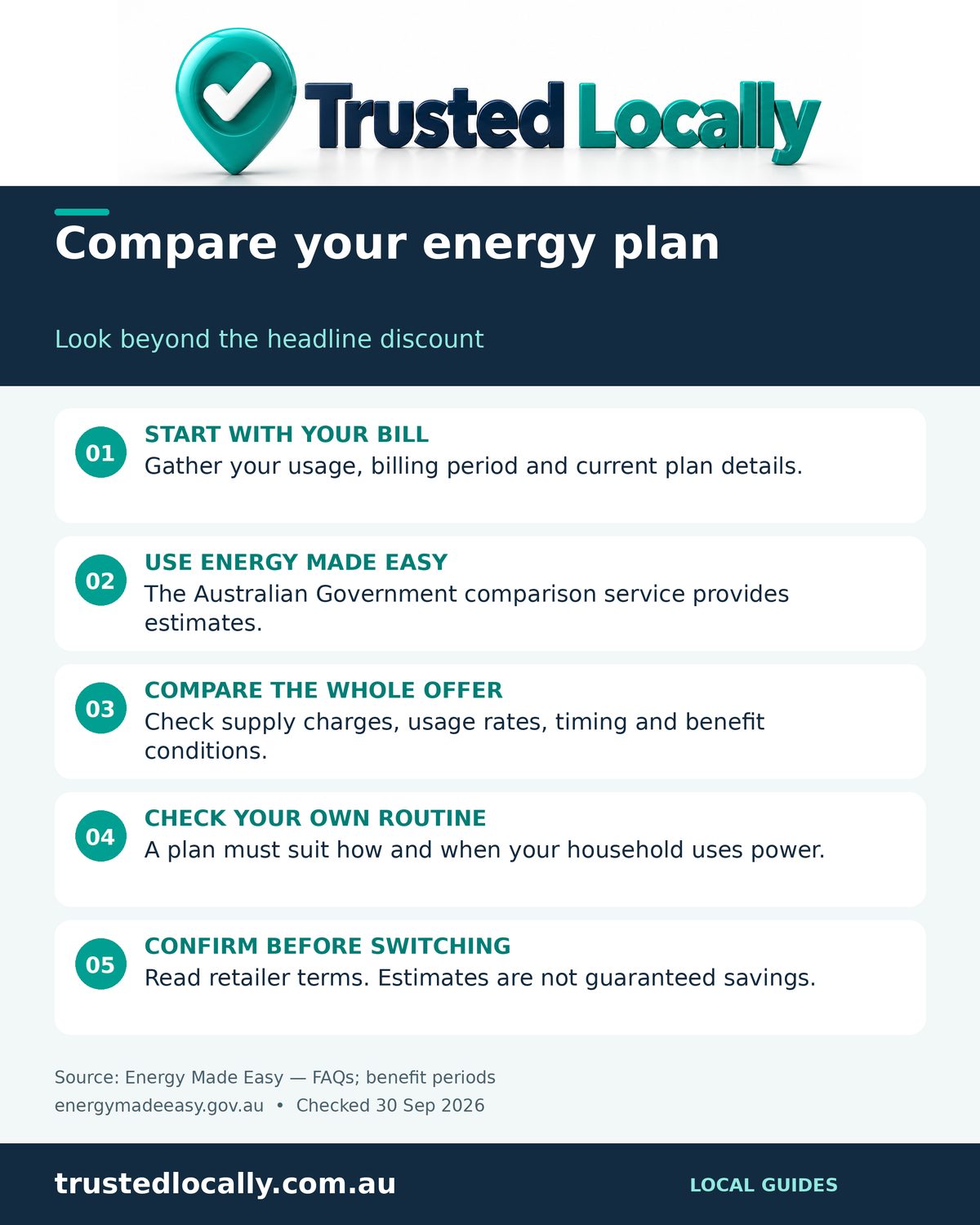
Step 1: Read your current bill properly
Find your most recent bill and note:
- Billing period and number of days.
- Total usage in kWh, and the daily average if shown.
- Tariff type: flat rate, time of use (peak, shoulder, off-peak) or a controlled load for hot water (Tariff 31 or 33 in Queensland).
- Daily supply charge in cents per day.
- Usage rate(s) in cents per kWh.
- Solar feed-in tariff and exported kWh, if you have panels.
- Any discount and what it is conditional on (pay on time, direct debit, email bills).
- Benefit period end date, if your plan has one.
If your routine has changed since the bill, adjust your expectations. Working from home, a new air conditioner, an electric vehicle or a change in household size can move your usage significantly. Four seasons of bills give the most reliable picture because Brisbane summers push usage up with cooling.
Keep personal account details private when asking for help. You can discuss rates in a community group without posting an unredacted bill.
Step 2: Use Energy Made Easy as your independent starting point
Energy Made Easy is the Australian Energy Regulator's free comparison service for households and small businesses in Queensland, New South Wales, South Australia, Tasmania and the ACT. Enter your postcode and either your usage from the bill or your National Metering Identifier (NMI) and the site estimates the annual cost of every generally available plan in your area.
Two cautions. The estimate is not a guaranteed future bill; it assumes your past usage continues. And the site does not switch you. If you choose a plan, you contact the retailer directly and they manage the transfer, which usually takes a few business days with no interruption to supply.
Step 3: Compare the whole offer, not the discount
A 20 per cent discount on a high usage rate can cost more than no discount on a low one. For each plan, look at:
Supply charge
The fixed daily amount you pay regardless of use. For a low-usage household such as a one-bedroom unit, the supply charge can be a third of the bill, so a low supply charge matters more than a low usage rate.
Usage rates and tariff structure
Flat rates are simple. Time-of-use plans reward households that can shift washing, dishwashers and pool pumps to off-peak times and penalise evening use. Be honest about whether your household will actually change its routine.
Conditional discounts
Check what the discount applies to (usage only, or the whole bill) and what triggers it. A pay-on-time discount is worthless if you occasionally pay late.
Solar feed-in and import
If you have solar, do not choose on the feed-in tariff alone. Plans with a high feed-in often have higher usage rates. Compare the net annual cost using your export and import figures together.
Fees and exit terms
Look for paper bill fees, payment processing fees, connection fees and whether there is an exit fee. Most market offers in Queensland have no exit fee, but check.
Step 4: Keep a simple comparison sheet
Three columns is enough. For each plan record: estimated annual cost from Energy Made Easy, supply charge, usage rate(s), discount and its conditions, feed-in tariff, benefit end date and any question you still need answered. Write one line on why the plan looks suitable for your household. If the reason depends on shifting your usage, decide whether that change is realistic before you switch. A saving that relies on a routine you will not keep is not a saving.
Step 5: Separate the plan from the appliance question
A high bill does not automatically mean the plan is wrong, and a new plan will not fix a faulty hot water system or an air conditioner that runs all day. First check whether the billing period, weather or occupancy changed. If usage has jumped with no explanation, consider an appliance check by a licensed electrician before switching plans. Ask for the call-out cost up front and keep the assessment separate from any sales pitch for new equipment. Trusted Locally lists licensed Brisbane electricians and air conditioning services with customer reviews, and our guide to choosing a tradie in Brisbane explains how to verify a licence.
Step 6: Check concessions and rebates
Queensland offers an electricity rebate for eligible pensioners, seniors card holders and some concession card holders, applied through your retailer. The Queensland Government has also provided one-off bill credits in some years. Check the Queensland Government's current energy concessions page and ask your retailer whether you are receiving everything you qualify for.
Step 7: Diarise the benefit end date
Energy Made Easy explains how benefit periods and contract terms work. When a benefit period ends, retailers can move you to a less competitive rate, and they must notify you beforehand. Put the end date in your calendar and repeat this comparison once a year, or when your bill arrives with a price change notice. Twenty minutes a year is usually enough to stay on a reasonable plan.
For plan comparisons, rely on Energy Made Easy and the retailer's written terms. For the appliance and wiring side of a high bill, Trusted Locally can help you find a licensed local electrician.
Frequently asked questions
What is the best way to compare electricity plans in Queensland?
Use Energy Made Easy, the Australian Energy Regulator's free comparison site. Enter your postcode and the usage from a recent bill and it estimates the annual cost of every available plan. Then compare supply charges, usage rates, discount conditions and benefit end dates before contacting the retailer.
Can I switch electricity providers in Brisbane?
Yes. South East Queensland households on the Energex network can choose their retailer. Contact the new retailer and they arrange the transfer, usually within a few business days, with no interruption to supply. Energy Made Easy does not switch you itself.
What is a benefit period on an electricity plan?
It is the period during which a plan's discounts or special rates apply. When it ends, the retailer may move you to different rates and must notify you in advance. Record the end date and compare plans again when it approaches.
Should I choose an electricity plan based on the solar feed-in tariff?
No. Plans with a high feed-in tariff often have higher usage rates or supply charges. Compare the net annual cost using both your exported and imported kWh from your bill.
Why is my electricity bill so high in Brisbane?
Common causes are summer cooling, a longer billing period, more people at home, a new appliance or a plan whose benefit period has ended. Check those first. If usage has jumped with no explanation, have a licensed electrician check appliances such as hot water systems and air conditioners.